---
title: Flow Temperature Set to Maximum – What It Means and How to Fix It
description: This alert appears when Homely has been requesting the maximum allowed flow temperature for most or all of the day, but the indoor temperature is still not reaching the target.
---
[Skip to content](https://help.homelyenergy.com/knowledge/flow-temperature-set-to-maximum-what-it-means-and-how-to-fix-it#main-content)
English
Show submenu for translations
[Contact us](https://help.homelyenergy.com/knowledge/kb-tickets/new?hsLang=en)
[![Homely logo white.png\]](https://help.homelyenergy.com/hs-fs/hubfs/Homely%20logo%20white.png?height=40&name=Homely%20logo%20white.png)](https://help.homelyenergy.com/knowledge?hsLang=en)
Open main navigation
Close main navigation
- English
Show submenu for translations
- [Contact us](https://help.homelyenergy.com/knowledge/kb-tickets/new)
How can we help?
- There are no suggestions because the search field is empty.
1. [Knowledge base](https://help.homelyenergy.com/knowledge?hsLang=en)
2. [Installer Troubleshooting](https://help.homelyenergy.com/knowledge/installer-troubleshooting?hsLang=en)
3. [Troubleshooting with Connect](https://help.homelyenergy.com/knowledge/installer-troubleshooting?hsLang=en#troubleshooting-with-connect)
# Flow Temperature Set to Maximum – What It Means and How to Fix It
### **Why you’re seeing this alert**
This alert appears when Homely has been requesting the **maximum allowed flow temperature** for most or all of the day, but the **indoor temperature is still not reaching the target**.
Put simply, Homely is already asking the heat pump for as much heat as it is permitted to deliver, and the home is not warming up. That usually points to a **system, installation, or settings limitation**, rather than an issue with Homely control.
### **What the alert typically looks like**
You will usually see all of the following:
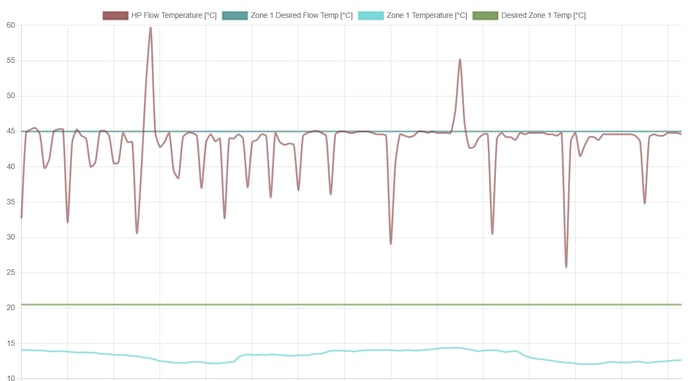
- **Set Flow Temperature** pinned at the configured maximum for long periods
- **Measured Flow Temperature** reaching, or closely tracking, that maximum (for example, ~45°C)
- **Indoor temperature** remaining below the set point
### **Common causes (and what to check)**
#### **1. Poorly placed node (misleading temperature data)**
**What happens**
If the node is located somewhere unrepresentative, such as a hallway, kitchen, in direct sun, near appliances, or in a space that is not influenced by the emitters Homely is controlling, Homely receives temperature data that does not reflect the main heated area. It then continues to call for maximum flow temperature because it never “sees” the space warming correctly.
**How to spot it**
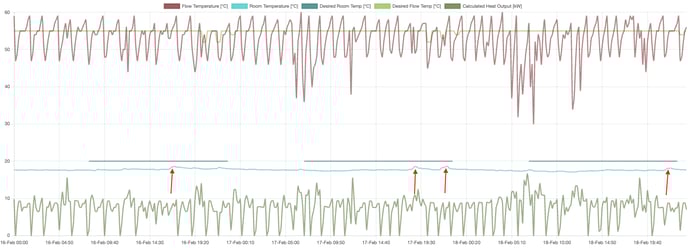
- Indoor temperature barely rises despite the heat pump working hard
- Unexpected temperature jumps when the heat pump is not actively heating (for example, cooking, sun gain, appliances)
- Node name or notes suggest a mixed or unsuitable location (for example, “kitchen-living”, “hallway”)
**Fix**
Move the node to a better reference location:
- In the main heated living area used most of the day
- Away from kitchens, corridors, direct sunlight, and heat sources
- Where the radiators or emitters being controlled can realistically influence the measured temperature
#### **2. Radiators or emitters are not releasing heat (delivery problem)**
**What happens**
The heat pump can achieve the requested flow temperature, but heat is not being emitted into the rooms. The home stays cold, so Homely continues requesting maximum flow temperature. Common causes include:
- Third-party thermostats or programmable TRVs closing down rooms
- Radiators manually turned off
- Air in radiators (bleeding required)
- Poor balancing or restrictions in the system
**How to spot it**
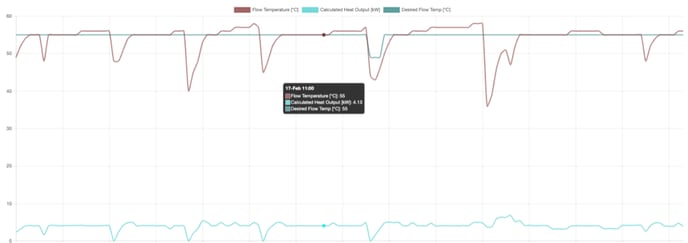
- Flow temperature is high, but rooms feel cool and emitters are not warming properly
- Heat output is much lower than expected for the heat pump size (for example, ~4 kW from a 10 kW unit)
- Large temperature differences across circuits that suggest poor flow, restrictions, or closed emitters
**Fix**
- Confirm all relevant emitters are open and calling for heat
- Remove control conflicts (disable or standardise third-party zoning/TRVs where appropriate)
- Bleed radiators and check system pressure
- Check balancing and verify adequate flow through the intended circuits
#### **3. Maximum flow temperature limit in Homely is set too low (ceiling problem)**
**What happens**
Homely will not request a flow temperature above the installer-set maximum. If that maximum is too low for the emitter type or building heat loss, the property may never reach target temperature, especially in colder weather. Homely then sits at that limit all day and triggers an alert.
**How to spot it**
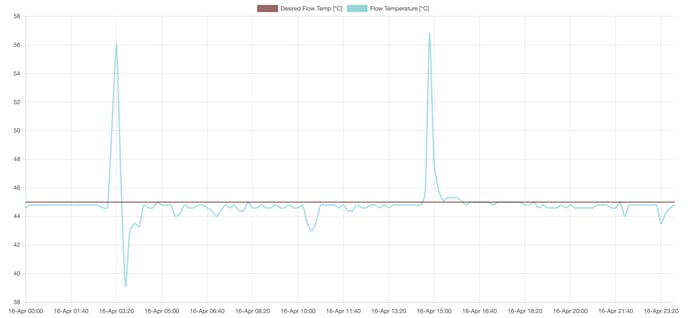
- Max flow temperature in Homely is unusually low for the system (for example, ~41°C on a radiator-led property)
- Set flow temperature is constantly at the maximum, but the home remains under temperature
**Fix**
Increase the maximum flow temperature limit in Homely to a value appropriate for either the emitter type or the manufacturer’s permitted operating limits, whichever is lower. More guidance on how to do that [here](https://help.homelyenergy.com/knowledge/how-to-update-flow-temperatures-in-connect?hsLang=en).
#### **4. The heating system is genuinely at its limit (capacity problem)**
**What happens**
Sometimes everything is installed and configured correctly, but the system cannot meet demand. Typical reasons include:
- Unrealistic targets (for example, 25°C indoors during very cold outdoor conditions)
- High heat loss (draughts, structural gaps, poor insulation)
- Undersized radiators or emitter capacity
- Heat pump undersized for the building
- Temporary abnormal heat loss (window left open, high ventilation)
**How to spot it**
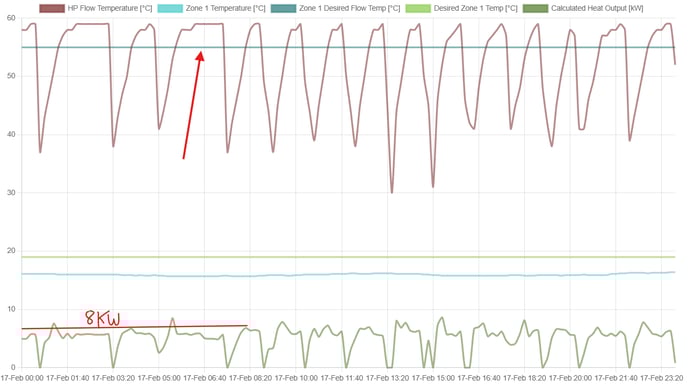
- Flow temperature at maximum
- Heat pump running at or near maximum output for extended periods
- Indoor temperature remains below target despite stable operation and no obvious control issues

**Fix**
If the pattern persists over several days:
- Investigate and reduce heat loss (draught-proofing, insulation, windows, ventilation behaviours)
- Review emitter sizing and distribution
- Assess heat pump sizing and design assumptions
- Reset expectations with the homeowner on achievable indoor temperatures in extreme conditions
- [Getting Started](https://help.homelyenergy.com/knowledge/getting-started?hsLang=en#main-content)
- [Your Homely System](https://help.homelyenergy.com/knowledge/getting-started?hsLang=en#your-homely-system)
- [Before you buy](https://help.homelyenergy.com/knowledge/getting-started?hsLang=en#before-you-buy)
- [Benefits of Homely](https://help.homelyenergy.com/knowledge/getting-started?hsLang=en#benefits-of-homely)
- [Heat Pump Functions](https://help.homelyenergy.com/knowledge/getting-started?hsLang=en#heat-pump-functions)
- [Using Homely](https://help.homelyenergy.com/knowledge/using-homely?hsLang=en#main-content)
- [Setting up your Preferences](https://help.homelyenergy.com/knowledge/using-homely?hsLang=en#setting-up-your-preferences)
- [Smart+ Features](https://help.homelyenergy.com/knowledge/using-homely?hsLang=en#smart-features)
- [Account Management](https://help.homelyenergy.com/knowledge/using-homely?hsLang=en#account-management)
- [Usage Data](https://help.homelyenergy.com/knowledge/using-homely?hsLang=en#usage-data)
- [Solar Sense](https://help.homelyenergy.com/knowledge/using-homely?hsLang=en#solar-sense)
- [Homeowner Troubleshooting](https://help.homelyenergy.com/knowledge/homeowner-troubleshooting?hsLang=en#main-content)
- [FAQs](https://help.homelyenergy.com/knowledge/homeowner-troubleshooting?hsLang=en#faqs)
- [Hardware](https://help.homelyenergy.com/knowledge/homeowner-troubleshooting?hsLang=en#hardware)
- [Switching to Heat Pump Controller](https://help.homelyenergy.com/knowledge/homeowner-troubleshooting?hsLang=en#switching-to-heat-pump-controller)
- [Heat Pump Errors](https://help.homelyenergy.com/knowledge/homeowner-troubleshooting?hsLang=en#heat-pump-errors)
- [Installer Resources](https://help.homelyenergy.com/knowledge/installer-resources?hsLang=en#main-content)
- [Why Homely](https://help.homelyenergy.com/knowledge/installer-resources?hsLang=en#why-homely)
- [Configuring Homely](https://help.homelyenergy.com/knowledge/installer-resources?hsLang=en#configuring-homely)
- [Compatibility and System Design](https://help.homelyenergy.com/knowledge/installer-resources?hsLang=en#compatibility-and-system-design)
- [Manuals](https://help.homelyenergy.com/knowledge/installer-resources?hsLang=en#manuals)
- [Connect](https://help.homelyenergy.com/knowledge/connect?hsLang=en#main-content)
- [About Connect](https://help.homelyenergy.com/knowledge/connect?hsLang=en#about-connect)
- [Managing Installations](https://help.homelyenergy.com/knowledge/connect?hsLang=en#managing-installations)
- [Installer Troubleshooting](https://help.homelyenergy.com/knowledge/installer-troubleshooting?hsLang=en#main-content)
- [Homely](https://help.homelyenergy.com/knowledge/installer-troubleshooting?hsLang=en#homely)
- [Troubleshooting with Connect](https://help.homelyenergy.com/knowledge/installer-troubleshooting?hsLang=en#troubleshooting-with-connect)
- [Samsung](https://help.homelyenergy.com/knowledge/installer-troubleshooting?hsLang=en#samsung)
[](https://www.homelyenergy.com)
www.homelyenergy.com
Copyright © 2026, Homely